Deep Work: Why Depth, Not Hours, Is the Skill That Matters
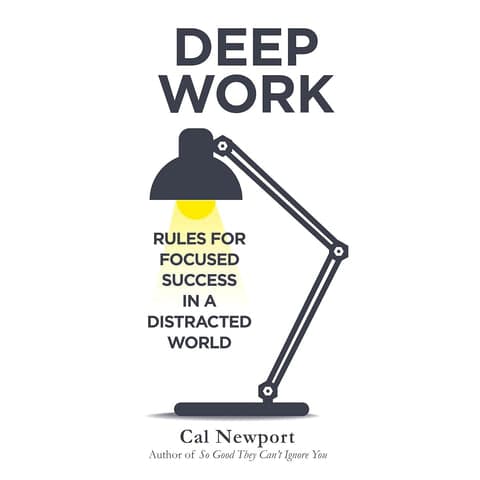
You've been "working" since 7 a.m. Email before you're properly awake, the school run, then calls that run into each other. A Teams thread quietly eats forty minutes. A quick check of your phone turns into a scroll you didn't plan on. By 9 p.m. the one task that actually mattered, the one that would have moved your real work forward, is sitting exactly where you left it that morning.
If that's your week, the problem isn't effort, and it probably isn't time. It's something the hours can't buy. That's the idea I took from Cal Newport's Deep Work: the bottleneck was never how many hours I put in. It was how deep I went in them.
The maths most of us get wrong
Newport sums up high-quality output like this:
High-Quality Work = Time Spent × Intensity of Focus
Most of us only ever push on the first number. We add hours, work later, call it dedication. But if focus is close to zero, more hours barely move the result. My longest weeks were often my least productive, and now I know why. I was multiplying a big number by almost nothing.
Focus isn't collapsing because we're weak, either. It's the environment, and what that environment has done to our attention.
Why focus got so hard
Two forces are working against you.
The first is attention residue. Every time you switch tasks, even for the second it takes to glance at a notification, a slice of your attention stays behind on the last thing. Researchers who watched people work near their phones found we get pulled off task roughly every 40 seconds. You can't think deeply on 40-second runways.
The second is your own brain rewiring itself. We love talking about neuroplasticity when it means picking up a language or building a good habit. We rarely admit it does the same job on the bad ones. Every flick between apps, every notification you check, every swipe to the next video trains your brain to expect a hit of novelty. You're laying down a fast, comfortable route to distraction while the slower routes to concentration go quiet from disuse.
So when you finally sit down to think hard about one thing for ninety minutes, your brain fights you. You're asking it to run a distance it hasn't trained for, in a room built to interrupt it, after months of being coached to crave the next ping. That feeling of working against yourself isn't a flaw in your character. It's what the training produced.
What deep focus actually feels like
The encouraging part is that the same plasticity rebuilds the focus pathways once you start using them again.
A good companion read here is Mihály Csíkszentmihályi's Flow, decades of research into that state where you're so absorbed the clock disappears and the work itself feels worth doing. Flow isn't luck. It tends to show up when the difficulty of a task is matched to your skill and nothing else is fighting for your attention.
There's a ceiling worth knowing about, too. Anders Ericsson, who spent a career studying top performers (concert musicians, chess grandmasters, elite athletes), found that even they manage only about four hours of genuinely deep work a day. Past that, quality drops off as the brain recovers from the strain. So if you're grinding eight, nine, ten hours, very little of it is deep. You're paying double the time for half the output. The fix isn't to be heroic. It's to train the muscle: start at 30 minutes, then an hour, then ninety, and build from there.
The Deep Work Blueprint
Here's a four-step version you can start this week.
1. Audit your deep-to-shallow ratio
Before you change anything, look honestly at where your hours go. Newport offers a quick test for any recurring task: how long would it take to train a smart, motivated newcomer to do it? If the honest answer is months, that's deep work. If it's a day or two, it's shallow, the stuff that fills a day without moving anything: messages, status meetings, tidying notes, updating spreadsheets. When I ran this on a normal week, I'd assumed maybe a third of my time was shallow. It was closer to two-thirds. That number stung, and it was what finally pushed me to change. (These days a lot of that shallow tier can be handed to AI tools, which only makes protecting the deep tier more worthwhile.)
2. Design your deep-work schedule
Newport lays out four ways to do this: total seclusion, occasional deep days, a daily block, or ad-hoc sessions. Unless you're an academic or fully self-employed, seclusion isn't realistic; most of us have a job, a family, a side project, or all three. The daily block is the one that actually works. Pick a window, even an hour, and defend it like a meeting with your most important client. Mine is the first couple of hours of the morning. Yours might be late at night. The slot matters less than the decision to carve it out and guard it.
3. Build an environment that does the work for you
This sounds obvious, and almost everyone gets it wrong: managing a distraction is not the same as removing it. A phone on your desk, face down and on silent, still drags on your working memory, because part of your mind is busy not picking it up. Willpower is the wrong tool. Put the phone in another room or a drawer, switch notifications off rather than to silent, and pick one place where you only ever do deep work: a home office, a library, a quiet table in a café. After a while your brain ties that place to concentration and slips into it on its own.
4. Get comfortable being bored, and score every session
Don't skip this one. It's the difference between a two-week experiment and a habit that holds. Every time you reach for your phone in a dull moment, the coffee queue, the lift, a red light, you teach your brain that boredom is an emergency to be fixed with stimulation. Then you sit down to focus and wonder why it keeps begging for a hit. So let the small moments stay boring. It feels uncomfortable at first; sit with it anyway, a little longer each time.
Then give each session a target. Not "work on the project", which is a procrastinator's favourite, but a small, finishable outcome inside a 60-to-90-minute window. A clear goal turns the session into something you can win, and the clock stops feeling like pressure and starts feeling like a game. Small wins build the habit faster than motivation ever will.
A deep life is a good life
The world is built to pull you toward the shallow end. Open offices, group chats, endless feeds, back-to-back calls, a chatbot for every spare minute, all of it tuned to take a slice of your attention. Choosing depth runs against that current, which is exactly why it's worth doing.
What I keep noticing is this: the days I felt most alive weren't the days I cleared the most email or sat through the most calls. They were the days I sat down and went deep on something that mattered to me. Newport's line for it is that a deep life is a good life. Give the work you care about your best hours, not the ones left over.
Based on Cal Newport's Deep Work, with ideas from Mihály Csíkszentmihályi's "Flow" and Anders Ericsson's research on deliberate practice.